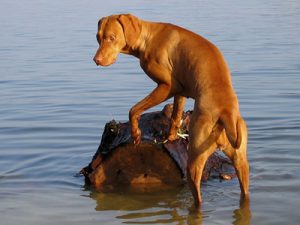
The Vizsla is a dog breed originating in Hungary. The Hungarian or Magyar Vizsla are elite sporting dogs and loyal companions, in addition to being the smallest of the all-round pointer-retriever breeds. The Vizsla’s medium size is one of the breed’s most appealing characteristics as a hunter of fowl and upland game, and through the centuries the Vizsla has held a unique position for a sporting dog – that of household companion and family dog.
The Vizsla is a natural hunter endowed with an excellent nose and an outstanding trainability. Although they are lively, gentle mannered, demonstrably affectionate and sensitive, they are also fearless and possessed of a well-developed protective instinct.
Appearance
The Vizsla is a medium-sized short-coated hunting dog of distinguished appearance and bearing. Robust but rather lightly built, they are lean dogs, have defined muscles, and are observed to share similar physical characteristics with the Weimaraner, the grey-blue dogs, and are similar in size.
Various breeds are often mistaken for Vizslas, and Vizslas are often mistaken for other breeds. Redbone Coonhounds, Weimaraners and Rhodesian Ridgebacks are some of the most commonly confused breeds. The body structure of a Vizsla is very similar in appearance to a Weimaranar and Redbone Coonhound, though the Vizsla is typically leaner with more defined musculature. Weimaranars and Rhodesian Ridgebacks are larger than Vizslas. The nose of the Vizsla will always have a reddish colour that blends with the coat colour. Black, brown, light pink, or another colour nose is an indication of another breed – or at least not a pure Vizsla. Eyes and nails should also blend with coat colour.
Colour and coats
The standard coat is a solid golden-rust colour in different shadings, but some breeding programs have resulted in a solid rust coat. The coat could also be described as a copper/brown colour, russet gold and dark sandy gold. Solid dark mahogany red and pale yellow are faulty. Small areas of white on the fore-chest and on the toes are permissible but not preferred. Some variations in the Vizsla coat colour along their back (saddle-type marks) is typical.
The American Kennel Club (AKC) breed standard for the Vizsla states that the coat should be short, smooth, dense and close-lying, without woolly undercoat. The Vizsla is totally unsuited to being kept outside, since unlike most other breeds, it does not have an undercoat. This lack of undercoat makes the Vizsla susceptible to the cold so it must not be kept in a kennel or left outside for extended periods of time. They are self-cleaning dogs and only need to be bathed infrequently, and are somewhat unique in that they have little noticeable “dog smell” detectable by humans. After several forays into lakes and streams they will develop an aroma that is a weaker version of the ‘wet dog’ smell. A quick bath and this odour will vanish.
Temperament
Vizslas are very high energy, gentle-mannered, loyal, caring, and highly affectionate. They quickly form close bonds with their owners, including children. Often they are referred to as “velcro” dogs because of their loyalty and affection. They are quiet dogs, only barking if necessary or provoked. Sometimes when these dogs feel neglected or want something, they will cry.
They are natural hunters with an excellent ability to take training. Not only are they great pointers, but they are excellent retrievers as well. They will retrieve on land and in the water, making the most of their natural instincts. However, they must be trained gently and without harsh commands or strong physical correction, as they have sensitive temperaments and can be easily damaged if trained too harshly. Vizslas are excellent swimmers and often swim in pools if one is available. Like all gun dogs, Vizslas require a good deal of exercise to remain healthy and happy.
The Vizsla thrives on attention, exercise, and interaction. It is highly intelligent, and enjoys being challenged and stimulated, both mentally and physically. Vizslas that do not get enough attention and exercise can easily become destructive or hyperactive. Under-stimulated Vizslas may also become depressed or engage in obsessive-compulsive behaviours such as persistent licking. Vizslas are very gentle dogs that are great around children. The Vizsla wants to be close to its owner as much of the time as possible. Many Vizslas will sleep in bed with their owners if allowed, burrowing under the covers.
—————————————————————————————————————–
CARING FOR YOUR DOG NEWSLETTER – Delivered Directly To Your Inbox – Starting Immediately – SIGN UP FOR FREE TODAY
—————————————————————————————————————–