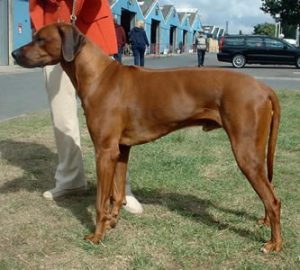
The Rhodesian Ridgeback is dog breed developed in Southern Africa where it was used (amongst other things) to hunt lions. This is most likely why this dog is known for its bravery. Its European forebears can be traced to the early pioneers of the Cape Colony of southern Africa, who crossed their dogs with the semi-domesticated, ridged hunting dogs of the Khoikhoi.
In the earlier parts of its history, the Rhodesian Ridgeback has also been known as Van Rooyen’s Lion Dogs, the African Lion Hound or African Lion Dog—Simba Inja in Ndebele, Shumba Imbwa in Shona—because of their ability to distract a lion while awaiting their master to make the kill.
The original breed standard was drafted by F.R. Barnes, in Bulawayo, Rhodesia (today known as Zimbabwe), in 1922. Based on that of the Dalmatian, the standard was approved by the South African Kennel Union in 1926.
Appearance
The Rhodesian Ridgeback’s distinguishing feature is the ridge of hair along its back, running in the opposite direction to the rest of its coat. It consists of a fan-like area formed by two whorls of hair (called “crowns”) and tapers from immediately behind the shoulders down to the level of the hips. The ridge is usually about 2 inches (5 cm) in width at its widest point. It is believed to originate from the dog used by the original African dog population, which carried a similar ridge. The first depiction of a Ridgeback is a wall painting describing the life of the Boers, housed in South African in the Voortrekker Monument.
Male Ridgebacks should stand 25–27 inches (63–69 cm) at the withers and weigh about 85 lb (39 kg) FCI Standard); females should be 24–26 inches (61–66 cm) tall and about 70 lb (32 kg) in weight. There is no such weight limit in the UK producing a more imposing dog. Ridgebacks are typically muscular and have a light wheaten to red wheaten coat, which should be short, dense, sleek and glossy in appearance, and neither woolly nor silky. White is acceptable on the chest and toes. The presence of black guard hairs or ticking is not addressed in the AKC standard, although the elaboration of the AKC standard notes the amount of black or dark brown in the coat should not be excessive. The FCI Standard states that excessive black hairs throughout the coat are highly undesirable. Ridgebacks sometimes have a dark mask.
Ridgebacks have a strong, smooth tail, which is usually carried in a gentle curve backwards. The eyes should be round and should reflect the dog’s colour—skin pigment, not coat colour: dark eyes with a black nose (regardless of coat colour), amber eyes with a liver nose. The liver nose is a recessive gene. It is not as common as a black nose; some breeders believe the inclusion of livernoses in a breeding program is necessary for maintaining the vibrancy of the coat.
The original standard allowed for a variety of coat colours, including brindle and sable. The modern FCI standard calls for light wheaten to red wheaten.
Other breeds with a ridge of fur along the spine include:
Phu quoc ridgeback dog, Vietnam
Thai Ridgeback
Combai of Tamilnadu, India
Temperament
Rhodesian Ridgebacks are loyal and intelligent. They are, however, aloof to strangers. This is not to be confused with aggression; a Ridgeback of proper temperament will be more inclined to ignore, rather than challenge, a stranger. This breed requires positive, reward-based training, good socialisation and consistency; it is often not the best choice for inexperienced dog owners. Ridgebacks are strong-willed, intelligent, and many seem to have a penchant for mischief, though loving. They are protective of their owners and families. If trained well, they can be excellent guard dogs.
Despite their athletic, sometimes imposing, exterior, the Ridgeback has a sensitive side. Excessively harsh training methods, that might be tolerated by a sporting or working dog, will likely backfire on a Ridgeback. The Ridgeback accepts correction as long as it is fair and justified, and as long as it comes from someone he knows and trusts. Francis R. Barnes, who wrote the first standard in 1922, acknowledged that “rough treatment … should never be administered to these dogs, especially when they are young. They go to pieces with handling of that kind.”
Ridgebacks do become nervous wrecks if they are treated harshly, a gentle and slow approach to training will make your Rhodesian Ridgeback an extremely strong, loyal and loving animal. Treating a Ridgeback harshly will backfire on you and will result in many behavioural problems (e.g. Destructive Chewing).They also love spooning in couches.
—————————————————————————————————————–
CARING FOR YOUR DOG NEWSLETTER – Delivered Directly To Your Inbox – Starting Immediately – SIGN UP FOR FREE TODAY
—————————————————————————————————————–
Related Posts: