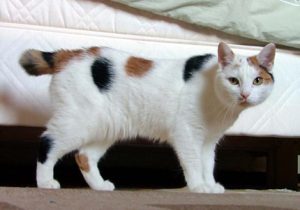
The Manx (Manx: Kayt Manninagh or Stubbin) is a breed of cat with a naturally occurring mutation of the spine. This mutation shortens the tail, resulting in a range of tail lengths from normal to tail-less. Many Manx have a small “stub” of a tail, but Manx cats are best known as being entirely tail-less; this is the distinguishing characteristic of the breed and a cat body type genetic mutation. The Manx are said to be skilled hunters, known to take down larger prey even when they are young. They are often sought by farmers with rodent problems.
Appearance
The hind legs of a Manx are longer than the front legs, creating a continuous arch from shoulders to rump giving the cat a rounded appearance. Ears are smaller than most cat breeds and Manx can come in any colour, including Tortoise-shell, Tabby, Calico, and all solid coat colours. Heads are round in shape, and often very expressive, with large, round eyes and small nose.
Tail length
Manx kittens are classified according to tail length:
Dimple rumpy or rumpy – no tail whatsoever
Riser or rumpy riser – stub of cartilage or several vertebrae under the fur, most noticeable when kitten is happy and raising its ‘tail’
Stumpy – partial tail, more than a ‘riser’ but less than ‘tailed’ (in rare cases kittens are born with kinked tails because of incomplete growth of the tail during development)
Tailed or longy – complete or near complete tail
Stubby – half tail, or short tail.
Tail length is random throughout a litter.
The ideal show Manx is the rumpy and the stumpy (No tails or Stubbed tails); tailed and “Stubbie” Manx do not qualify to be shown, unless shown in an AOV (Any Other Variety) Class. In the past, kittens with stumpy or full tails have been docked at birth as a preventative measure due to some partial tails being very prone to a form of arthritis that causes the cat severe pain.
Some dishonest cat dealers have been known to chop off the tails of “normal” kittens and sell them as Manx.
Coat
Manx cats exhibit two coat lengths. The short-haired Manx has a double coat with a thick, short under-layer and a longer, coarse outer-layer with guard hairs. The long-haired Manx, known to some cat registries as the Cymric, has a silky-textured double coat of medium length, with britches, belly and neck ruff, tufts of fur between the toes and full ear furnishings. The Cat Fanciers’ Association (CFA) considers the Cymric to be a variety of Manx and judges it in the short-hair division, while The International Cat Association (TICA) judges it in the long-hair division. Short- or long-haired, all Manx have a thick double-layered coat.
—————————————————————————————————————–
CARING FOR YOUR CAT NEWSLETTER – Delivered Directly To Your Inbox – Starting Immediately – SIGN UP FOR FREE TODAY
—————————————————————————————————————–
Related Posts: