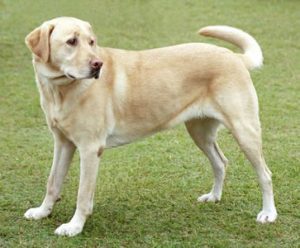
The Labrador Retriever (also Labrador, or Lab for short) is one of several kinds of retriever, a type of gun dog. They have webbed paws for swimming, useful when they retrieve their prey, hence the name retriever. The Labrador, once known as the Lesser Newfoundland, is the most popular breed of dog (by registered ownership) in the world, and is, by a large margin, the most popular breed by registration in Canada, the United States (since 1991), and the United Kingdom. It is also the most popular breed of assistance dog in Canada, the United States, Australia, United Kingdom and many other countries, as well as being widely used by police and other official bodies for their detection and working abilities. Typically, Labradors are athletic, and love to swim, play catch and retrieve games, and are good with young children.
Appearance
Labradors are relatively large, with males typically weighing 29–41 kg (65-90 pounds) and females 25–32 kg (55–71 lb). Labs weighing close to or over 100 lbs are considered obese or having a major fault under American Kennel Club standards, although some labs weigh significantly more. The majority of the characteristics of this breed, with the exception of colour, are the result of breeding to produce a working retriever.
As with some other breeds, the Conformation (typically “English”, “show” or “bench” and the Field (typically “American” or “working” lines differ, although both lines are bred in both countries. In general, however, Conformation Labs tend to be bred as medium-sized dogs, shorter and stockier with fuller faces and a slightly calmer nature than their Field counterparts, which are often bred as taller, lighter-framed dogs, with slightly less broad faces and a slightly longer nose; however Field labs should still be proportional and fit within AKC standards. With field labs, excessively long noses, thin heads, long legs and lanky frames are not considered standard. These two types are informal and not codified or standardised; no distinction is made by the AKC or other kennel clubs, but the two types come from different breeding lines. Australian stock also exists; though not seen in the west, they are common in Asia.
The breed tends to shed hair twice annually, or regularly throughout the year in temperate climates. Some labs shed a lot; however, individual labs vary. Labrador hair is usually fairly short and straight, and the tail quite broad and strong. The otter-like tail and webbed toes of the Labrador Retriever make them excellent swimmers. The webbing between their toes can also serve as a “snowshoe” in colder climes and keep snow from balling up between their toes- a condition that can be painful to other breeds with hair between the toes. Their interwoven coat is also relatively waterproof, providing more assistance for swimming.
Official breed standards
There is a great deal of variety among Labs. The following characteristics are typical of the conformation show bred (bench-bred) lines of this breed in the United States, and are based on the AKC standard. Significant differences between US and UK standards are noted.
Size: Labs are a medium-large but compact breed. They should have an appearance of proportionality. They should be as long from the withers to the base of the tail as they are from the floor to the withers. Males should stand 22.5–24.5 inches (57–62 cm) tall at the withers and weigh 65–80 lb (29–36 kg). Females should stand 21.5–23.5 inches (55–60 cm) and weigh 55–70 lb (25–32 kg). By comparison under UK Kennel Club standards, height should be 22–22.5 inches (56–57 cm) for males, and 21.5–22 inches (55–56 cm) for females.
Coat: The Lab’s coat should be short and dense, but not wiry. The coat is described as ‘water-resistant’ or more accurately ‘water-repellent’ so that the dog does not get cold when taking to water in the winter. That means that the dog naturally has a slightly dry, oily coat. Acceptable colours are black, yellow (ranging from ivory or creme to fox red), and chocolate.
Head: The head should be broad with a pronounced stop and slightly pronounced brow. The eyes should be kind and expressive. Appropriate eye colours are brown and hazel. The lining around the eyes should be black. The ears should hang close to the head and are set slightly above the eyes.
Jaws: The jaws should be strong and powerful. The muzzle should be of medium length, and should not be too tapered. The jaws should hang slightly and curve gracefully back.
Body: The body should be strong and muscular with a level top line.
The tail and coat are designated “distinctive [or distinguishing] features” of the Labrador by both the Kennel Club and AKC. The AKC adds that “true Labrador Retriever temperament is as much a hallmark of the breed as the ‘otter’ tail.”
As well, Labradors should not have droopy eyes (like a Basset Hound). The skin should be relatively tight, and you should not be able to see the pinks on the inside of their lids.
Temperament
Labradors are a well-balanced, friendly and versatile breed, adaptable to a wide range of functions as well as making very good pets. As a rule they are not excessively prone to being territorial, pining, insecure, aggressive, destructive, hypersensitive, or other difficult traits which sometimes manifest in a variety of breeds. As the name suggests, they are excellent retrievers. Labradors instinctively enjoy holding objects and even hands or arms in their mouths, which they can do with great gentleness (a Labrador can carry an egg in its mouth without breaking it). They are also known to have a very soft feel to the mouth, as a result of being bred to retrieve game such as waterfowl. They are prone to chewing objects (though they can be trained out of this behaviour). The Labrador Retriever’s coat repels water to some extent, thus facilitating the extensive use of the dog in waterfowl hunting.
Labradors have a reputation as a very mellow breed and an excellent family dog (including a good reputation with children of all ages and other animals), but some lines (particularly those that have continued to be bred specifically for their skills at working in the field rather than for their appearance) are particularly fast and athletic. Their fun-loving boisterousness and lack of fear may require training and firm handling at times to ensure it does not get out of hand—an uncontrolled adult can be quite problematic. Females may be slightly more independent than males. Labradors mature at around three years of age; before this time they can have a significant degree of puppyish energy, often mislabelled as being hyperactive. Because of their enthusiasm, leash-training early on is suggested to prevent pulling when full-grown. Labs often enjoy retrieving a ball endlessly and other forms of activity (such as agility, frisbee, or flyball).
Although they will sometimes bark at noise, especially noise from an unseen source (“alarm barking”, Labs are usually not noisy or territorial. They are often very easygoing and trusting with strangers, and therefore are not usually suitable as guard dogs.
Labradors have a well-known reputation for appetite, and some individuals may be highly indiscriminate, eating digestible and non-food objects alike. They are persuasive and persistent in requesting food. For this reason, the Labrador owner must carefully control his/her dog’s food intake to avoid obesity and its associated health problems.
The steady temperament of Labs and their ability to learn make them an ideal breed for search and rescue, detection, and therapy work. Their primary working role in the field continues to be that of a hunting retriever.
—————————————————————————————————————–
CARING FOR YOUR DOG NEWSLETTER – Delivered Directly To Your Inbox – Starting Immediately – SIGN UP FOR FREE TODAY
—————————————————————————————————————–