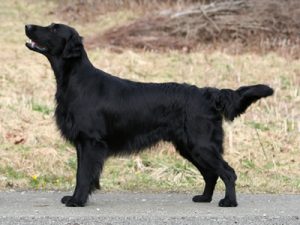
The Flat-Coated Retriever is a gundog breed from the United Kingdom. It was developed as a retriever on both land and in the water.
Appearance
The Flat-Coated Retriever breed standard calls for males to be 23–24.5 inches (58–62 cm) tall at the withers and for females to be 22–23.5 inches (56–60 cm), with a recommended weight of 55–75 lb (24–34 kg). Flat-Coated Retrievers have strong muscular jaws and a relatively long muzzle to allow for the carrying of birds and upland game. Their head is unique to the breed and is described as being “of one piece” with a minimal stop and a backskull of approximately the same length as the muzzle. They have almond shaped dark brown eyes that have an intelligent, friendly expression. The ears are pendant, relatively small and lie close to the head. The occiput (the bone at the back of the skull) is not to be accentuated (as it is in setters, for example) with the head flowing smoothly into a well-arched neck. The topline is strong and straight with a well feathered tail of moderate length held straight off the back. Flat-coats should be well angulated front and rear, allowing for open, effortless movement. They are lighter, racier and more elegant in appearance than the other retriever breeds.
Coat
The Flat-coat’s colour is either solid black or solid liver (a deep, rich brown), more commonly the former. Occurring rarely is a coat colour of solid yellow, but this is a disqualification under the conformation breed standard. While these yellow or cream coloured dogs cannot compete in conformation shows, they can compete in other activities such as field, agility and obedience trials. The single coat (there is no undercoat) is moderate in length, dense, and lustrous; ideally it should lie flat and straight, but a slight wave is permissible. Body coat is of moderate length with longer feathering on the backs of the legs, chest, under body, tail and feet.
Temperament
The Flat-coat’s personality is described as outgoing, devoted, and friendly, an ideal companion with a strong bond to its owner and family. It is a versatile hunting dog, retrieving well on land or in the water, flushing upland game, marking downed birds, and generally performing all the tasks expected of a multi-purpose gundog. Although not as well known and much less popular than the Labrador and Golden Retrievers, it has benefited from that lack of popularity by enjoying more careful breeding and better maintenance of its working ability.
Flat-coats love to please, but may be slightly more difficult to train than Golden Retrievers and Labradors. They are easily bored with repetitive training techniques and can exhibit a streak of wilfulness at times. For this reason, it is best to make training sessions fun, varied, and relatively short for the dog. Flat-coats are very sensitive and respond best to positive reinforcement. They cannot tolerate harsh handling or corrections.
Flat-coats are known for having a sunny optimism and a tail that is always wagging. They are capable of getting along well with cats, other dogs, small pets, and strangers. However, due to their exuberant nature, they may tend to knock over very small children. Socialisation and obedience training are highly recommended. Flat-coats are known to demonstrate their affectionate natures by frequently kissing their human friends. They also display an unusual habit with their canine friends: the “flat-coat kiss”, where the dogs lick each other’s mouths as a form of greeting. Since they are inclined to be friendly to all, they make only adequate watchdogs to give warning.
Flat-coats tend to have a good deal of energy, especially when young, and need to have appropriate outlets for this energy. They need plenty of activity and stimulation, both physical and mental, throughout their lives. Sometimes they are referred to as the “Peter Pan of retrievers” retaining their playful, optimistic outlook on life into old age.
—————————————————————————————————————–
CARING FOR YOUR DOG NEWSLETTER – Delivered Directly To Your Inbox – Starting Immediately – SIGN UP FOR FREE TODAY
—————————————————————————————————————–
Related Posts: