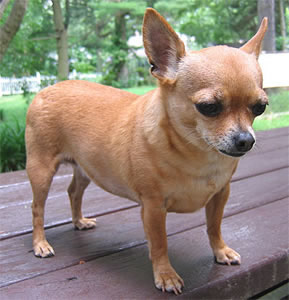
The Chihuahua (Spanish: Chihuahueño) is the smallest breed of dog and is named after the state of Chihuahua in Mexico.
Description and standards
Breed standards for this dog do not generally specify a height, only a weight and a description of their overall proportions. As a result, height varies more than within many other breeds. Generally, the height ranges between six and ten inches. However, some dogs grow as tall as 12 to 15 inches (30 to 38 cm). Both British and American breed standards state that a Chihuahua must not weigh more than six pounds for conformation. However, the British standard also states that a weight of two to four pounds is preferred and that if two dogs are equally good in type, the more diminutive or smaller is preferred. The Fédération Cynologique Internationale (FCI) standard calls for dogs ideally between 1.5 and 3.0 kg (3.3 to 6.6 lbs.), although smaller ones are acceptable in the show ring. Pet-quality Chihuahuas (that is, those bred or purchased as companions rather than show dogs) often range above these weights, even above ten pounds if they have large bone structures or are allowed to become overweight. This does not mean that they are not purebred Chihuahuas; they do not meet the requirements to enter a conformation show. Oversize Chihuahuas are seen in some of the best, and worst, bloodlines. Typically the breed standard for both the long and short coat chihuahua will be identical except for the description of the coat.
Chihuahua breeders often use terms like miniature, teacup, tiny toy, apple headed, or deer headed, to describe puppies. These terms are not recognised by the breed standards and may be misleading.
Coat
The Kennel Club in the United Kingdom and the American Kennel Club in the United States only recognise two varieties of Chihuahua: the long-coat, the smooth-coat, also referred to as short-haired. They are genetically the same breed. The term smooth-coat does not mean that the hair is necessarily smooth, as the hair can range from having a velvet touch to a whiskery feeling. Long-haired Chihuahuas are actually smoother to the touch, having soft, fine guard hairs and a downy undercoat, which gives them their fluffy appearance. Unlike many long-haired breeds, long-haired Chihuahuas require no trimming and minimal grooming. Contrary to popular belief, the long-haired breed also typically sheds less than their short-haired counterparts. It may take up to two or more years before a full long-haired coat develops.
Temperament
Being naturally territorial and protective, Chihuahuas can be easily provoked to attack, and are therefore generally unsuitable for homes with small children. A Chihuahua who is pack leader of their humans may snap at children. This breed is generally not recommended for children, not because they are not good with them, but because most people treat the Chihuahua differently than they would a large dog, causing them to become untrustworthy. The AKC describes the breed as, “A graceful, alert, swift-moving little dog with saucy expression, compact, and with terrier-like qualities of temperament.” The breed tends to be fiercely loyal to one particular owner, but may be attached to more. They do not always get along with other breeds, and tend to have a “clannish” nature, often preferring the companionship of other Chihuahuas over other dogs. These traits generally make them unsuitable for households with children that are not patient and calm.
Chihuahuas crave attention, affection, exercise and being petted. They can be hyper, but eager to please. They have a reputation as a “yappy” dog, which can be resolved with proper training. Chihuahuas with proper breeding are not “yappy”; the AKC standard calls for “a terrier-like attitude.”
—————————————————————————————————————–
CARING FOR YOUR DOG NEWSLETTER – Delivered Directly To Your Inbox – Starting Immediately – SIGN UP FOR FREE TODAY
—————————————————————————————————————–
Related Posts: