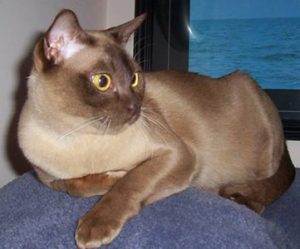
The Burmese (Thai: subh-bha-lak meaning fortunate, beautiful, and splendid appearance) is a breed of domesticated cats split into two subgroups: the American Burmese and the British Burmese (and are not to be confused with “Sacred Cat of Burma,” in respect of which, see Birman). Most modern Burmese are descendants of one female cat called Wong Mau, who was brought from Burma to America in 1930. Most cat registries do not recognise a split between the two groups, but those that do formally refer to the type developed by British cat breeders as the European Burmese.
Originally, Burmese cats were exclusively brown (sable), but years of selective breeding have produced a wide variety of colours. Different associations have different rules about which of these count as Burmese. Burmese cats are known for being sociable and friendly with humans, as well as intelligent. They are very vocal, and often call to their owners.
Characteristics
Accepted eye colour for the breed is gold or yellow, although interbreeding with Siamese may lead to blue or green. Blue eyes or teal (“aqua”Wink eyes, are genetically impossible in a pure Burmese cat. The coat is known for being glossy, with a satin-like finish. As with most short-hairs, it requires no additional grooming. The shape of the British breed is more moderate but must not be Oriental, while the American breed is sturdier in build. Longer lived than most pedigree cats, they often reach 16 to 18 years of age. Burmese are a small to medium size breed and tend to be about 4-6kg in weight, even though the breed are a lot heavier than they first appear.
Burmese are vocal like the Siamese but have softer, sweeter meows. They are people oriented, forming strong bonds with their owners, gravitating toward all human activity and can become a strong companion to their owners. Burmese are well known to need a reasonable amount of human attention, are not as independent as other breeds and are not suited to being left alone for extended periods of time. The Cat Fanciers’ Association (CFA) breed information on the Burmese implies that all survival instinct of flight or fight seems to have been bred out of them. However, other sources note that, while rarely aggressive with humans, Burmese cats tend to be able to defend themselves quite well against other cats, even those larger than themselves.
Burmese maintain kitten interests and energy throughout their adulthood and are very athletic and playful. In some instances they even retrieve items as part of a game. Burmese can also be trained to jump through hoops (similar to the jumping cats at Inle Lake, Burma), are comfortable travelling in cars and have even been documented to partake in caving.
Controversy
For the past thirty years, there has been controversy over the appearance of the breed, which can now be divided into two camps. American breeders prefer the “contemporary Burmese” (“American Burmese”Wink which has shorter noses and rounder skulls. The “traditional Burmese” (or “British Burmese”Wink was declassed by the Cat Fanciers’ Association in the 1980s. England’s Governing Council of the Cat Fancy took the opposite approach and banned the registration of all Burmese imported from America in order to preserve the “traditional” bloodlines.
The controversy revolves around the fact that “contemporary Burmese” sometimes carry alleles for the “Head Fault”, a lethal head defect. The head fault rarely occurs with “traditional Burmese”. Its widespread presence in the American lineages goes back to a cat named Good Fortune Fortunatas, a fine example of the “contemporary” body/head type, although the defect was present in Burmese cats before Fortunatas. This individual was extensively mated to Burmese cats in the USA, and today’s show-type American Burmese cats can usually trace their lineage back to it.
“Contemporary Burmese” Breeders have continued with their stock because defective kittens are stillborn or euthanized soon after birth, and because sterilisation of all possible head fault carriers would decimate the U.S. Burmese gene pool. While the average, non-breeding pet owner does not ever have to deal with the head fault, it is hoped that the “head fault” allele will eventually be eliminated by a yet-undiscovered genetic test, and then by years of controlled breeding.
Leslie A. Lyons, Ph.D. from University of California, Davis is doing research to locate the gene mutation that is causing the head fault. Resolving these problems would be highly useful, as the “head fault” allele appears to be expressed in recessive or epistatic manner. Therefore, eliminating it from the gene pool by simply culling affected animals is likely a prolonged process, if it can at all be successful (recessive alleles are rarely ever entirely eliminated from all but the most inbred gene pools). A genetic test for the presence of the allele would enormously speed up the process.
—————————————————————————————————————–
CARING FOR YOUR CAT NEWSLETTER – Delivered Directly To Your Inbox – Starting Immediately – SIGN UP FOR FREE TODAY
—————————————————————————————————————–
Related Posts: